Singapore vs Malaysia Cost of Living 2026: The Real Gap (70 Data Points)
70 verified data points across housing, income, taxes, transport, food and healthcare. The definitive 2026 SG vs MY cost of living comparison.
Try the Calculator
SGD to MYR Converter — live mid-market rate
Apply what you read — get an instant result.
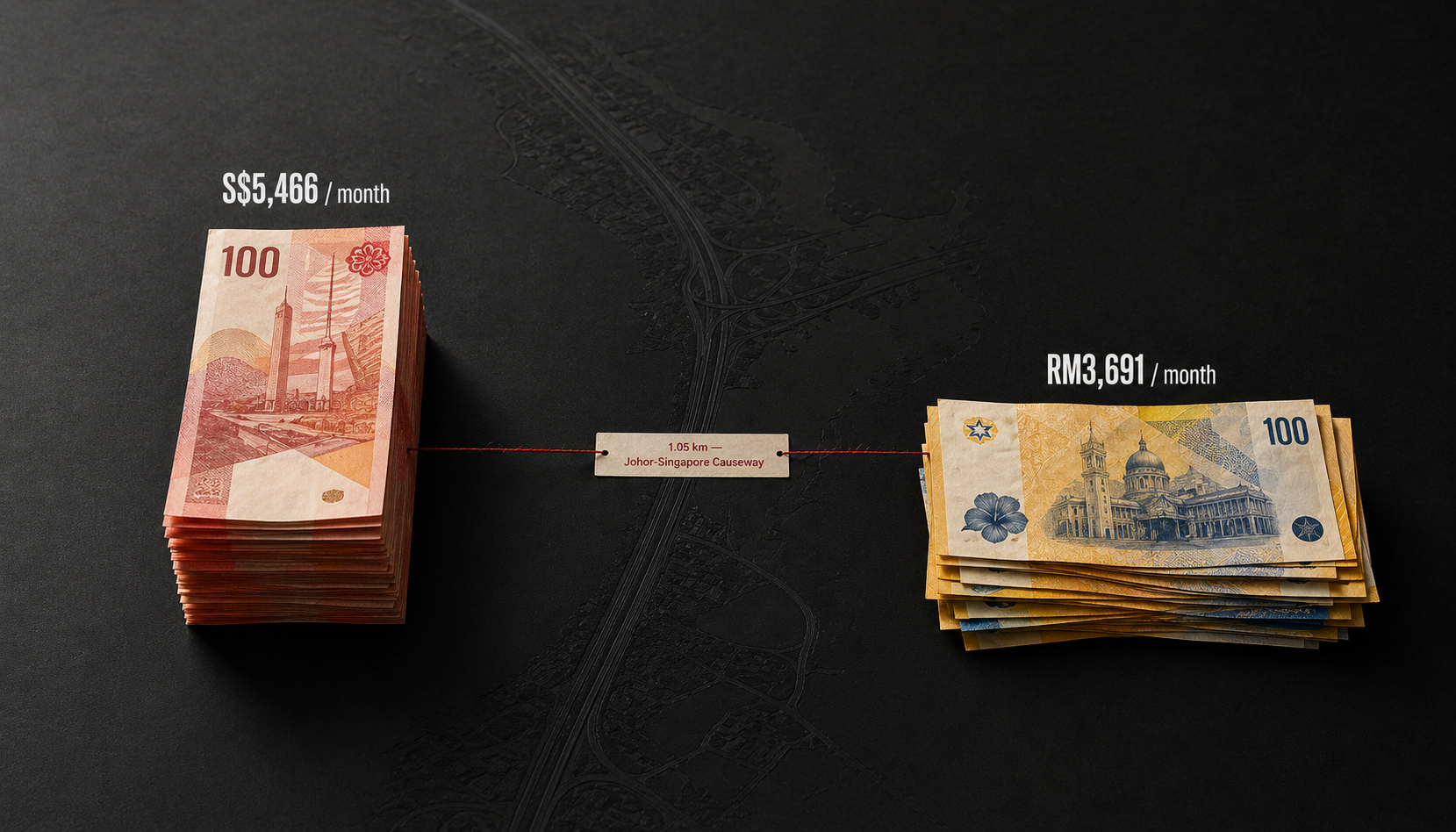
Singapore vs Malaysia Cost of Living 2026: 70 Data Points That Show the Real Gap
The Johor-Singapore Causeway is 1.05 kilometres long. In 2025, the Singapore Immigration & Checkpoints Authority cleared 244,864,000 travellers across the country's land borders — an average of 671,000 a day, peaking at 530,000 across the Causeway and Tuas Second Link in a single day during the Hari Raya Haji weekend in June 2024. It is the busiest international land border in Southeast Asia and one of the busiest on Earth.
It is also one of the steepest economic gradients on Earth. Cross those 1.05 kilometres in either direction and almost every price you can name doubles, triples, or — in the case of a new car — quintuples. Singapore is currently the fifth most expensive country in the world by Numbeo's 2026 index, tied for first place on the Economist Intelligence Unit's last full Worldwide Cost of Living survey. Malaysia, despite sharing a coastline and a colonial history, sits below the global median.
A Toyota Corolla in Singapore costs S$174,275. The same car across the border costs RM139,514 — about S$44,977. A litre of petrol costs S$3.05 at a Shell station in Woodlands. At the same Shell brand 1.05 kilometres away in Johor Bahru, Malaysians fill up for RM1.99 — S$0.64. A Singapore household earns a median market income of S$12,446 a month. A Malaysian household, RM7,017 (S$2,263). The same hawker chicken rice that costs S$5.50 in Tanjong Pagar costs RM7.50 in Skudai.
This is the most comprehensive Singapore-vs-Malaysia data piece on the internet. It pulls 70 data points from 26 primary sources — including Singapore's Department of Statistics, IRAS, HDB, LTA, the CPF Board, and ICA; Malaysia's DOSM, LHDN, KWSP, and Ministry of Finance; the World Bank, IMF, EIU, Mercer, and Numbeo. Every Singapore government figure has been verified against its primary gov.sg source. Every section is anchored to the live SGD-MYR exchange rate via our currency converter. The numbers below are accurate as of late April 2026.
If you're trying to choose between the two countries, working across them, or just trying to understand why the same dish costs you twice as much on one side of a 1.05-kilometre bridge — this is the math.
Key takeaways
A Singaporean household earns roughly 5.5 times what a Malaysian household earns in median monthly market income. The cost of living in Malaysia, including rent, is 70.6% lower than in Singapore. The cost-per-square-foot of buying a city-centre apartment in Singapore is 10.94 times higher than in Kuala Lumpur. The April 2026 Cat E Certificate of Entitlement closed at S$125,002 — the right to register a car, before buying one. Petrol is roughly five times more expensive at the pump in Singapore than for Malaysians using the BUDI95 subsidy. Singapore's mandatory CPF rate of 37% of wages exceeds Malaysia's EPF rate of 23–24% by 13 percentage points. Singapore's GST is 9%; Malaysia's combined sales-and-service tax sits between 5% and 10% depending on category. Cumulative Singaporean investment in Iskandar reached RM45.8 billion by September 2023, around a quarter of all foreign investment in the zone. Malaysia revamped its My Second Home (MM2H) visa in June 2024, with the Silver tier now requiring a US$150,000 fixed deposit and a RM600,000 property purchase. The Johor-Singapore Rapid Transit System is targeted for late December 2026, though Malaysian reporting has hinted at a possible January 2027 commencement.
Live Calculator
Convert any Singapore salary to Malaysian Ringgit
The average net Singapore salary — S$5,466 — equals RM16,954 at today's rate.
1. The headline indexes: Singapore as a global outlier
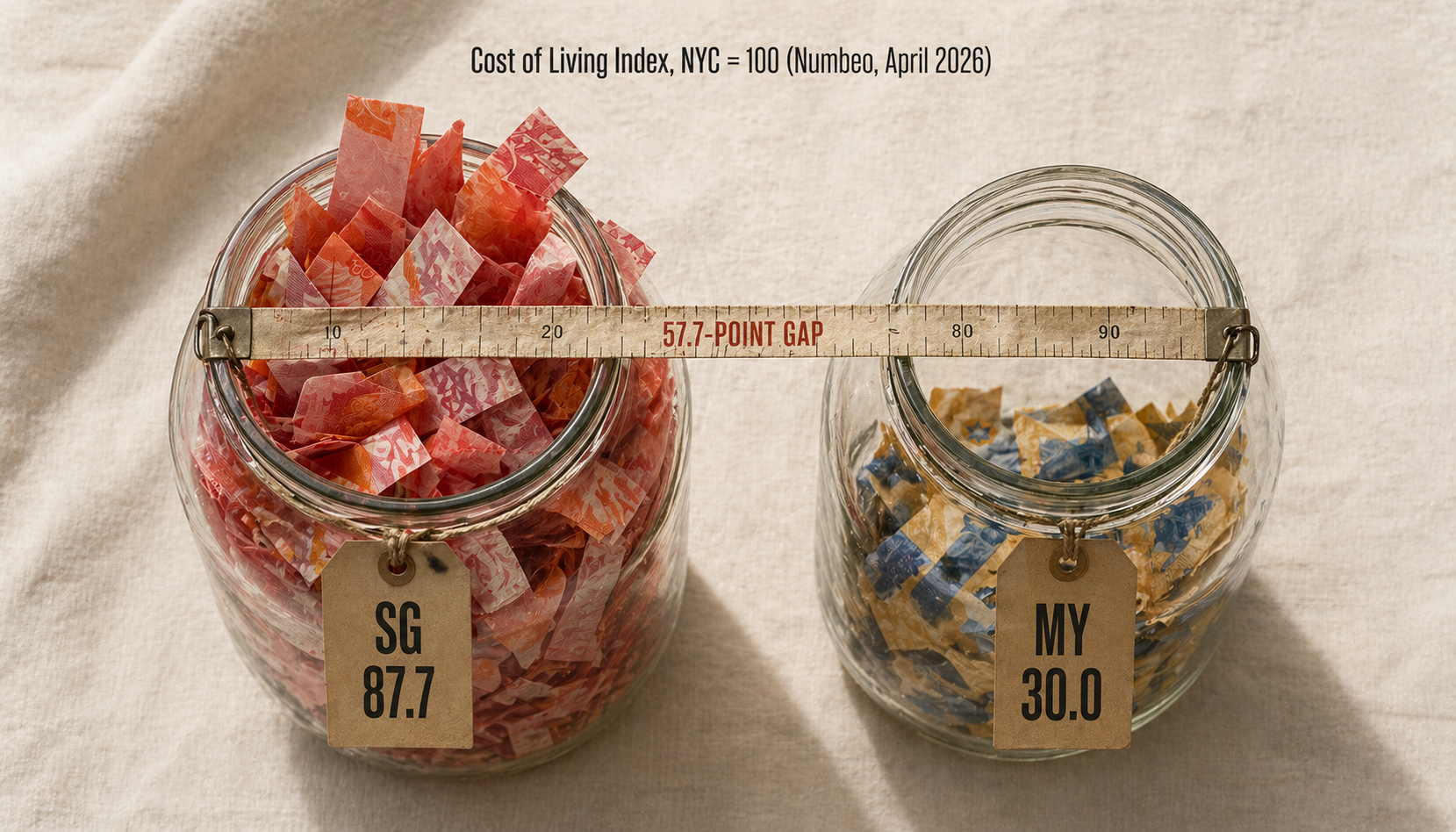
In Numbeo's February 2026 update, Singapore scored 87.7 on a Cost of Living Index where New York is 100. Malaysia scored roughly 30 — below the global median of 30.8. That makes Singapore the fifth most expensive country in the world by this measure and Malaysia the 104th. They are direct neighbours.
Numbeo also computes pairwise differentials between any two countries. Compared to Singapore, the cost of living in Malaysia is 60.7% lower excluding rent, and 70.6% lower including rent. Reframed for headlines: Singapore is roughly 156% more expensive than Malaysia ignoring rent and 240% more expensive factoring it in. Rent alone accounts for the steepest gap — apartments in Malaysia rent for 86.5% less than equivalent units in Singapore. Restaurant prices are 54.5% lower, groceries 46.2% lower.
The index methodology rewards Singapore's salaries somewhat: local purchasing power (median income adjusted for local prices) is only 25.9% higher in Singapore than in Malaysia. Translation: Singaporeans earn substantially more, but they also spend it on substantially more expensive things, leaving the actual standard of living closer than the headline-cost gap suggests.
To match the lifestyle of someone earning S$12,000 a month in Singapore — assuming you rent rather than own — you'd need only S$4,290 (RM13,175) in Kuala Lumpur. In Penang or Ipoh, less still.
The other major indexes confirm the gap. The Economist Intelligence Unit's 2024 Worldwide Cost of Living Index ranked Singapore tied for first (with Zurich) among 173 cities measured. Mercer's 2025 Cost of Living City Ranking placed Singapore at #6 globally and Kuala Lumpur at #155. Whether you're a multinational HR department, an expat insurance underwriter, or a tourist Googling "is Singapore expensive," the answer has been the same for half a decade.
2. Housing: where the gap is largest
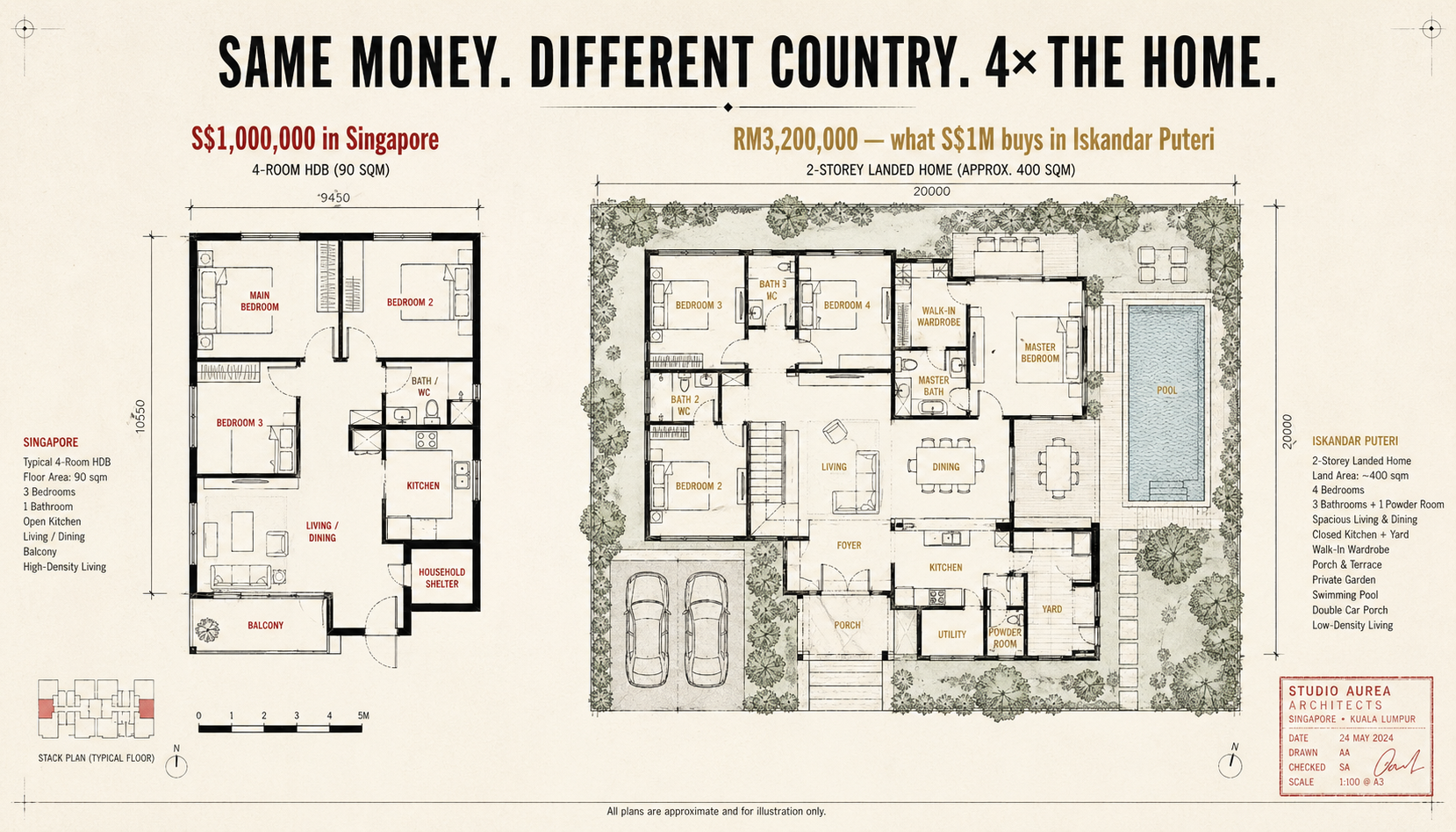
The single biggest divergence between the two countries — the one that shapes everything from career choices to retirement planning — is the cost of putting a roof over your head.
A square foot of city-centre apartment in Singapore costs an average of S$2,793.59. The same square foot in Kuala Lumpur costs RM792.22 — about S$255. That's a ratio of 10.94 times. Move outside the city centre and the ratio narrows slightly: S$1,925.85 per square foot in Singapore versus RM441.06 (S$142) in KL. To buy one Singapore city-centre apartment, you can purchase eleven equivalent KL apartments outright.
For renters the gap is smaller but still extraordinary. A one-bedroom in central Singapore rents for an average of S$3,427.74 a month. The same one-bedroom in central KL rents for RM1,616.30 — S$521. A three-bedroom in central Singapore: S$7,013.46. In KL: RM2,873.11 (S$926). Mortgage rates compound the difference — a 20-year fixed in Singapore is around 2.66%, against 4.28% in Malaysia, but Singapore's principal is so much larger that monthly payments still tilt steeply.
Singapore's HDB resale market, which houses about 80% of citizens, has just ticked into a long-anticipated correction. The Q1 2026 HDB Resale Price Index closed at 203.4 — down 0.1% quarter-on-quarter and up just 1.2% year-on-year. It is the first quarterly decline since Q2 2019, when the index fell 0.2%. There were 6,285 resale transactions in Q1 2026, up 19.6% from 5,256 in the previous quarter as supply finally caught up with demand. Million-dollar resales — once the exception — totalled 412 transactions in Q1 alone, according to PropNex and OrangeTee analyses of HDB transaction data. The highest single sale was a five-room loft at SkyTerrace @ Dawson, on Block 92 Dawson Road, that crossed at S$1.7 million.
Median resale prices for a four-room flat in mature estates now exceed seven figures: S$1,038,000 in Queenstown, S$1,000,000 in Toa Payoh, per HDB's Q1 2026 release. URA's Private Residential Property Price Index rose 0.9% in Q1 2026, accelerating from 0.6% in Q4 2025. Some 13,500 HDB flats are projected to reach Minimum Occupation Period in 2026, the largest cohort of upgraders in years.
In Malaysia, a comparable household budget unlocks a different category of property altogether. RM3.2 million — the rough ringgit equivalent of S$1 million — buys a four-bedroom landed home in Iskandar Puteri with a swimming pool, parking for three cars, and views of either the Strait of Johor or a manicured golf course. In Penang, the same money buys a renovated heritage shophouse on Beach Street. In KL, a 2,500 sq ft penthouse in Mont Kiara.
This is not an aesthetic difference. It is the central economic fact of cross-border life in this region.
Live Calculator
HDB Affordability Calculator
Estimate your BTO or resale budget based on income and CPF savings.
3. Income, wages, and what your money actually buys
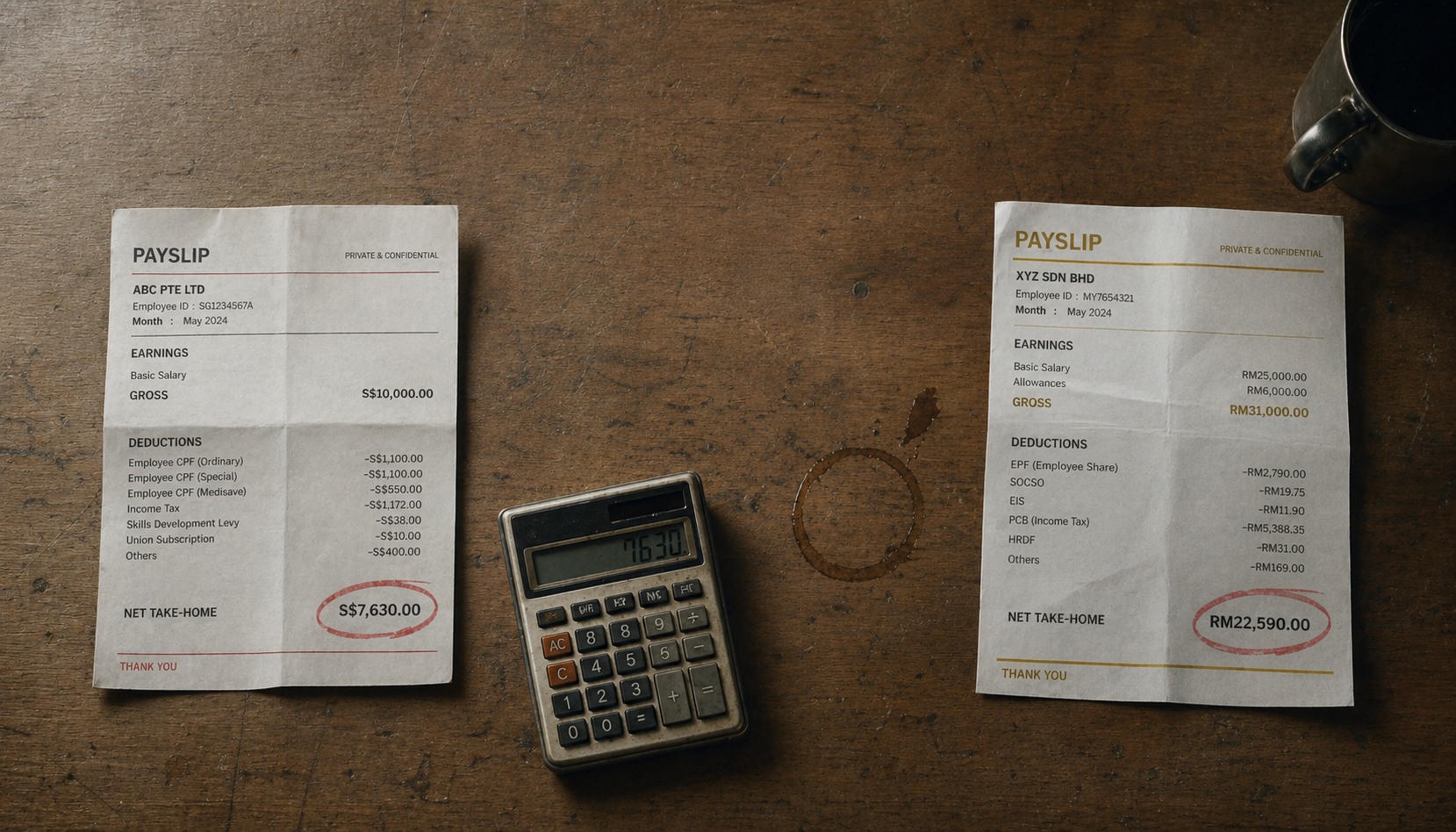
The income gap is the closest thing to good news for the Singapore side of the ledger.
Singapore's Department of Statistics published its 2025 Key Household Income Trends in February 2026. The median monthly market income for resident households rose to S$12,446, up 7.7% nominally from S$11,558 in 2024. The median monthly household employment income for resident employed households — a slightly narrower measure — was S$11,297 for 2024 (the 2025 figure has not been separately published). On a per-household-member basis, accounting for household size, Singapore's median income reached S$4,160 a month — up 8.4% nominally and 7.5% in real terms.
Malaysia's Department of Statistics last surveyed household income in 2024, publishing the results in October 2025. The median monthly household income for the country was RM7,017 — about S$2,263. Translated into a directly comparable measure with Singapore's market income figure, Singapore's median household earns roughly 5.5 times what Malaysia's does.
But Malaysia's headline figure understates regional variation considerably. Kuala Lumpur's median household income reached RM10,805 (S$3,485) — comfortably above the national average. Johor state, which abuts Singapore and absorbs most cross-border commuters, was RM7,712 (S$2,488). Selangor, the country's wealthiest state, hit RM10,253. At the other end, Kelantan's median was RM4,083 (S$1,317). Malaysia's top decile of households earns a mean monthly income of RM20,662 (S$6,665) — roughly comparable to Singapore's median household. The bottom decile averages RM3,815 (S$1,231).
Numbeo's net-salary measure, which strips out taxes and mandatory contributions, places Singapore's average at S$5,466 a month and Malaysia's at RM3,691 (S$1,189) — a ratio of roughly 4.6 to 1. This is the figure most expat-oriented salary comparisons cite, though the household-level medians are more rigorous.
A point worth pausing on: Singapore has no statutory minimum wage. The Ministry of Manpower instead operates a sectoral Progressive Wage Model and a Local Qualifying Salary for low-wage workers. Malaysia's federal minimum wage is RM1,700 a month, phased in from February 2025 and effective for all employers from August 2025. For the bottom decile of workers, this is the single biggest structural difference between the two labour markets.
What does that mean in practice? A median Singaporean earner takes home substantially more in dollar terms — but pays for it across every category of consumption already detailed above. A purchasing-power adjustment (the Numbeo calculation) closes the entire 5.5x income gap to roughly 1.26x. The Singaporean is materially better off, but not nearly by the multiple that nominal wages suggest. This is the central paradox the rest of this article documents.
Live Calculator
Singapore Salary Calculator
See your exact gross-to-net pay including CPF deductions.
4. Taxes, CPF, and the question of what you actually keep
Singapore's reputation as a tax haven is half-true. The headline rates are genuinely competitive: personal income tax for residents progresses from 0% to 24%, with the 24% top rate kicking in only above S$1,000,000 of chargeable income — a threshold reached by about 0.1% of taxpayers in any given year. Most working Singaporeans sit somewhere between the 7% and 15% effective rates. Non-residents face a flat 24% on most income, or 15% on employment income (whichever is higher) from Year of Assessment 2024. The personal income tax rebate for YA 2025 was 60% of tax payable, capped at S$200.
Malaysia's progressive scale tops out at 30% — six percentage points above Singapore — but the threshold is RM2,000,000 (about S$645,000). Special rates exist for designated zones: Iskandar Knowledge Workers earning above RM20,000 a month qualify for a flat 15%. Forest City's Special Financial Zone offers MM2H residents bespoke regimes. The headline picture is straightforward: Malaysia takes a higher marginal slice of high earners, Singapore a lower one.
Then there is the tax that isn't called a tax.
Singapore's Central Provident Fund is the country's mandatory retirement, healthcare, and housing system. For employees aged 55 and below as of 2026, the total CPF contribution is 37% of wages — split 17% from the employer and 20% from the employee. The Ordinary Wage ceiling rose to S$8,000 a month effective 1 January 2026 (up from S$7,400 in 2025), with a CPF Annual Salary Ceiling of S$102,000 and a CPF Annual Limit of S$37,740 (unchanged). Foreign workers — those on Employment Passes, S Passes, or Work Permits — do not contribute to CPF. The system is reserved for citizens and Permanent Residents.
Malaysia's Employees Provident Fund (EPF / KWSP) takes far less. For employees earning above RM5,000, the total contribution is 23% of wages — 12% employer, 11% employee. Below RM5,000 the employer share rises to 13%, total 24%. There is no Ordinary Wage ceiling equivalent to Singapore's CPF cap, but there is also no annual contribution limit. From 1 October 2025, foreign employees in Malaysia became subject to a 2% + 2% mandatory EPF contribution — a structural shift narrowing the cross-border labour calculus, though still less burdensome than the no-foreign-CPF Singapore equivalent.
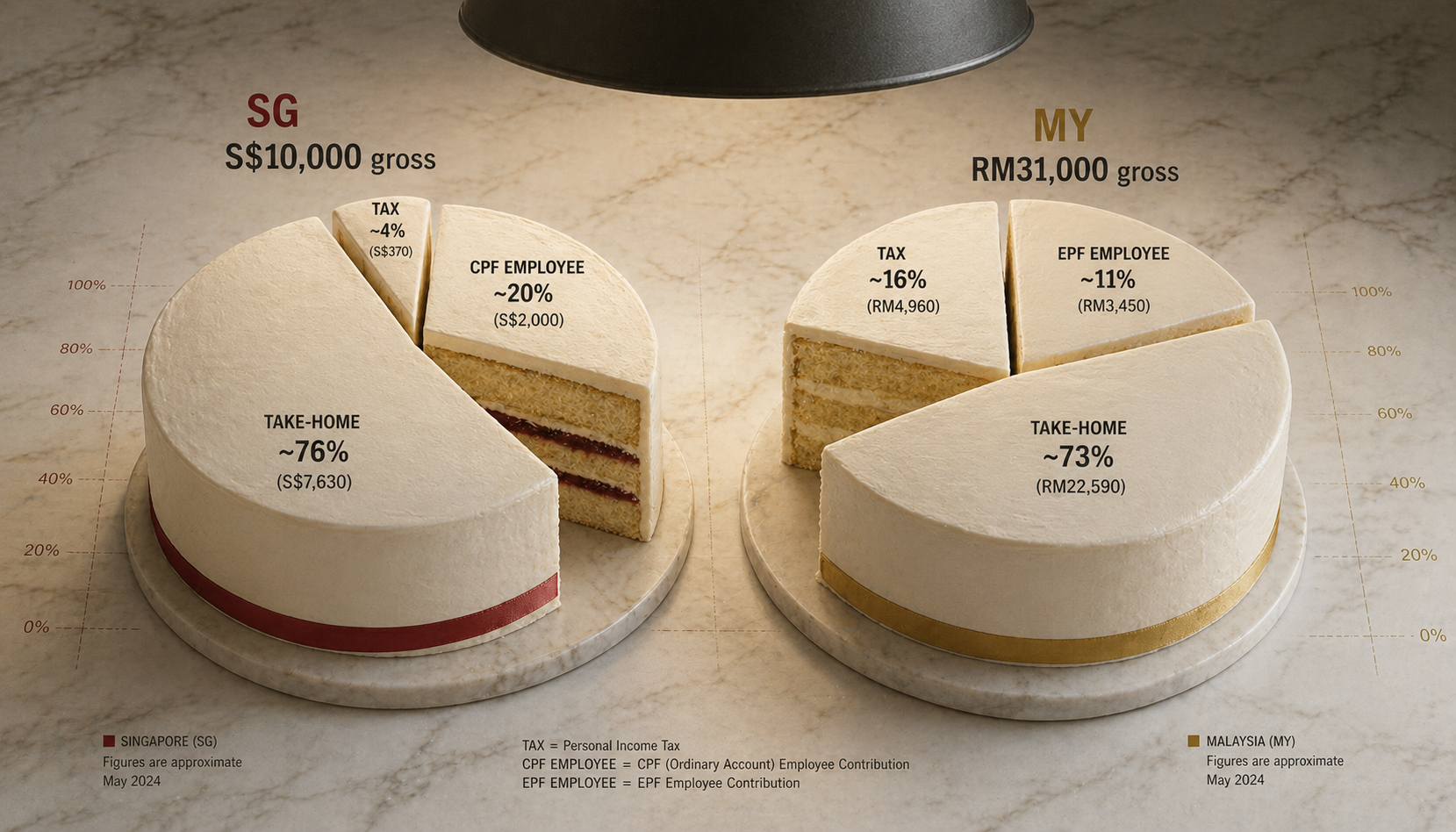
The combined effect: a Singapore resident earning S$10,000 a month at age 30 contributes roughly S$2,000 in employee CPF and pays about S$370 in income tax — a take-home of S$7,630, or 76% of gross. A Malaysian earning the equivalent RM31,000 a month contributes about RM3,410 in EPF and pays roughly RM5,000 in income tax — a take-home of about RM22,590 (S$7,287), or 73% of gross. The percentages converge, even if the absolute numbers diverge dramatically.
On consumption taxes, the two countries have moved in opposite directions in recent years. Singapore raised GST to 9% on 1 January 2024 — the second of two one-percentage-point increases originally announced in Budget 2022. Malaysia operates a Sales and Service Tax (SST) since abolishing GST in 2018: 5–10% Sales Tax on goods, 6–8% Service Tax on services, with the service tax scope expanded from 1 July 2025. Healthcare for non-Malaysians at private hospitals became subject to 6% service tax from that date.
Live Calculator
CPF Contribution Calculator
See your exact CPF split by age band at any income level.
5. Transport: the COE shocker
Of all the price gaps in this article, the most viscerally absurd is the one for cars.
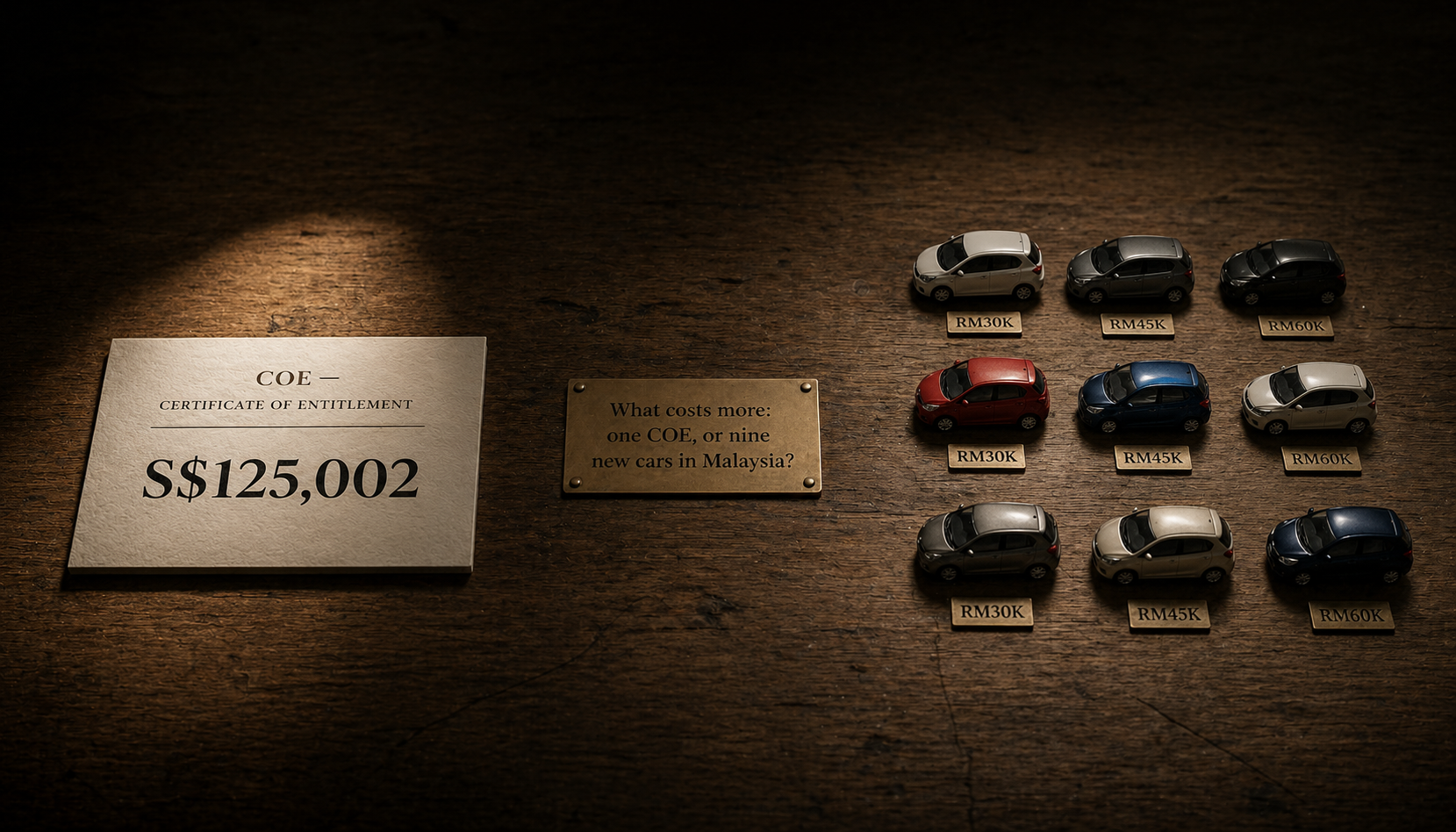
In April 2026's second bidding exercise, announced 22 April, the Certificate of Entitlement closed at the following prices: Cat A (cars up to 1,600cc, 130bhp), S$123,010. Cat B (above), S$121,001. Cat C (commercial), S$83,501. Cat D (motorcycle), S$9,290. Cat E (open category), S$125,002.
Read those numbers carefully. A COE is not a car. It is the right to register a car. It is a piece of paper, valid for ten years, that the Land Transport Authority auctions twice a month under a quota system designed to keep the country's vehicle population from growing beyond what the road network can absorb. Without it, you cannot put a single vehicle on Singapore's roads. With it, you've spent S$120,000 — and you still need to buy the actual car, pay registration fees, road tax, insurance, ARF, excise, and GST.
Add the COE to a typical mid-size sedan and you arrive at the Numbeo-tracked figure for a new Toyota Corolla equivalent in Singapore: S$174,275.
In Malaysia, the same car retails for RM139,514 — about S$44,977. The gap is S$129,298, or 287% on a like-for-like basis. To make the absurdity visceral: the cost difference between buying that Corolla in Singapore versus Malaysia is enough to buy a second Corolla in Malaysia and still have S$84,000 left over. Or, to invert the comparison: in April 2026, the COE alone — the piece of paper, with no car attached — costs roughly the same as four to nine new cars in Malaysia, depending on the model.
Petrol follows the same logic. In late April 2026, the unsubsidised pump price for 95-octane petrol in Singapore was approximately S$3.00–S$3.10 per litre at major retailers, with the Straits Times reporting S$3.08/L on 20 April. Singapore does not regulate retail petrol prices, and there is no published government series — these figures come from major operators (Shell, Esso, Caltex, SPC, Sinopec).
In Malaysia, the unsubsidised RON95 retail price for the week of 23–29 April 2026 was RM3.87 per litre (S$1.25). For Malaysian citizens enrolled in the BUDI95 subsidy programme, the price drops to RM1.99 per litre — about S$0.64. That makes Singapore petrol roughly 4.8 times more expensive than the subsidised Malaysian rate, or 2.4 times more expensive than the unsubsidised one. Foreigners and Singapore-registered vehicles pay the unsubsidised rate or the slightly lower SPCS rate of RM2.05/L at participating border stations.
Public transit costs lean the same direction, less dramatically. A one-way ticket on Singapore's MRT averages S$2.00; in KL on Rapid Rail Transit, it's RM3.00 (S$0.97). A monthly transit pass: S$122 in Singapore, RM50 (S$16.12) in KL — a 7.6× gap.
The underlying explanation is straightforward: Singapore is a city-state of 5.92 million people on 735 square kilometres. The COE system was designed in 1990 explicitly to control car population growth by auctioning a fixed quota. Malaysia is a country of 33.93 million on 330,803 square kilometres — 450 times the land area — with a domestic auto industry built on Proton and Perodua, and fuel subsidies treated as a citizen entitlement. The two transport economies are not just different. They are designed for different problems.
In late December 2026, those economies will be physically connected. The Johor Bahru–Singapore Rapid Transit System (RTS) Link is targeted to begin passenger service: a 4-kilometre route between Bukit Chagar in JB and Woodlands North in Singapore, with a five-minute journey time and capacity for 10,000 passengers per hour per direction. Singapore's Ministry of Transport has held the line on the December target as recently as June 2025. Malaysian reporting (Bernama, April 2026) has hinted at a possible January 2027 commencement; we'll know which is right by year-end.
Live Calculator
Total Cost of Car Ownership Calculator
Calculate the true 10-year cost of owning a car in Singapore, inclusive of COE.
6. Food, groceries, and the basket math
Most Singaporeans visiting Johor Bahru on a weekend understand the food gap intuitively. The data confirms the intuition.
A standardised 21-item Numbeo grocery basket priced in both countries reveals the structural pattern. Inexpensive restaurant meal: S$13 in Singapore, RM15 (S$4.84) in Malaysia — a 63% gap. Mid-range three-course dinner for two: S$80 versus RM80 (S$25.79) — 68% gap. McDonald's combo: S$10 versus RM20 (S$6.45). A cappuccino: S$6.05 against RM11.64 (S$3.75). A pint of domestic draft beer: S$10 against RM15 (S$4.84). A bottle of mid-range wine: S$32.50 against RM78 (S$25.15). A pack of Marlboros: S$17.62 against RM18 (S$5.80) — Singapore's tobacco taxes drive the largest single-item differential in the basket.
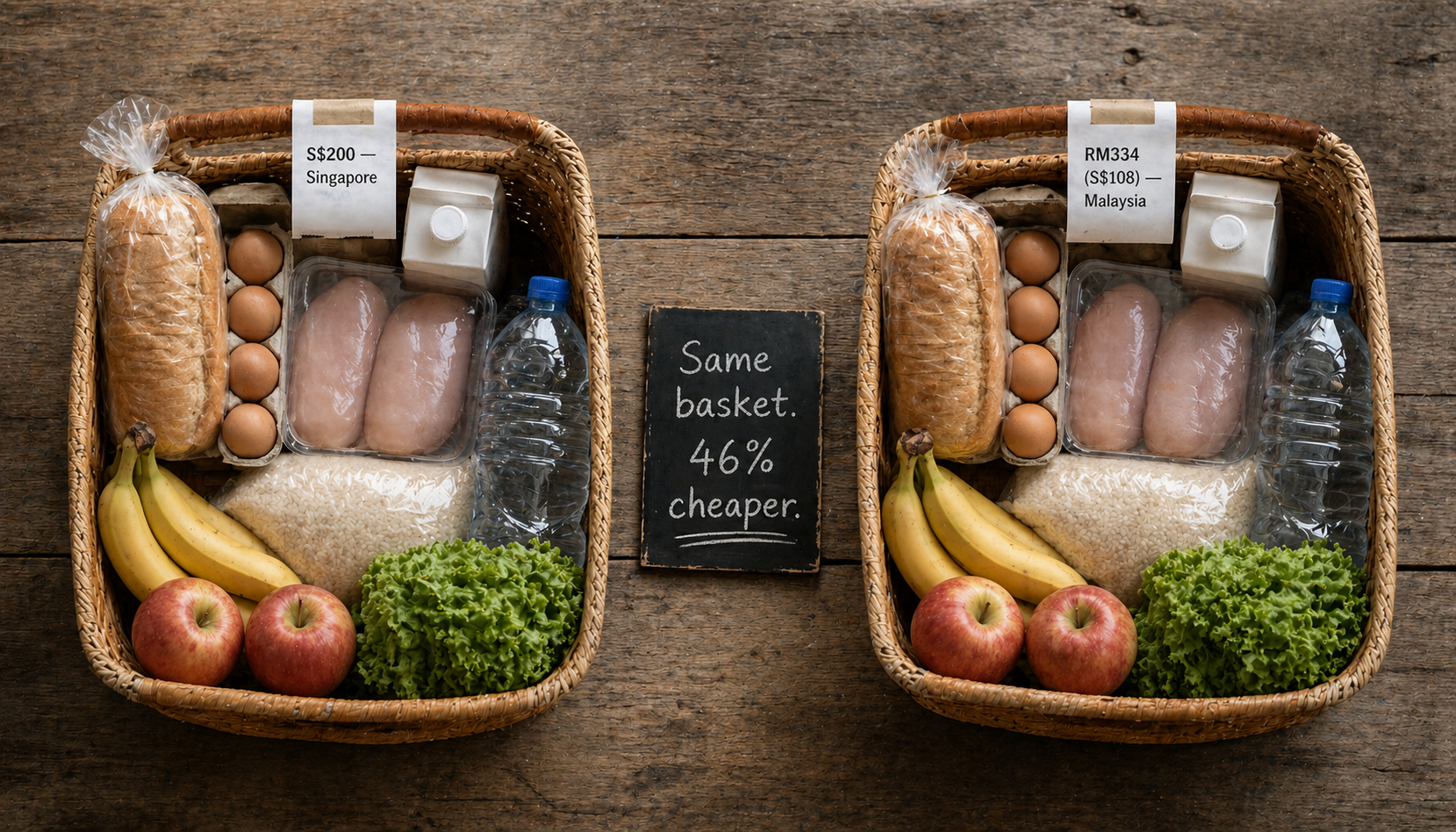
Across the 21-item basket, a Singapore household pays approximately S$200; a Malaysian household pays the equivalent of about S$108. The grocery components alone — milk, bread, eggs, chicken, beef, apples, bananas, tomatoes, potatoes, onions, lettuce, rice, water — show consistent 30–60% price gaps in Malaysia's favour.
The one cultural-economic exception worth flagging: hawker food. A plate of chicken rice in a typical Singapore food court costs S$5.50–6.50. A plate of nasi ayam at a JB mamak costs RM8–10 (S$2.58–3.23). The Singapore version is roughly 80–110% more expensive — a smaller gap than the restaurant-meal index would predict, because Singapore's hawker culture has been deliberately preserved as a low-cost food infrastructure. UNESCO recognised it as Intangible Cultural Heritage in 2020. The math nevertheless still favours Malaysia.
7. Healthcare: a six-fold spending gap
Healthcare comparisons between the two countries are often muddied by methodology. Let us be clear about what we know.
The Ministry of Health Singapore reports total government health expenditure of approximately S$16.9 billion in FY2021. Divided by the resident population at the time (~5.45 million), this works out to roughly S$3,100 per capita in government health spending. (MOH does not publish an explicit per-capita figure; the derivation is ours.)
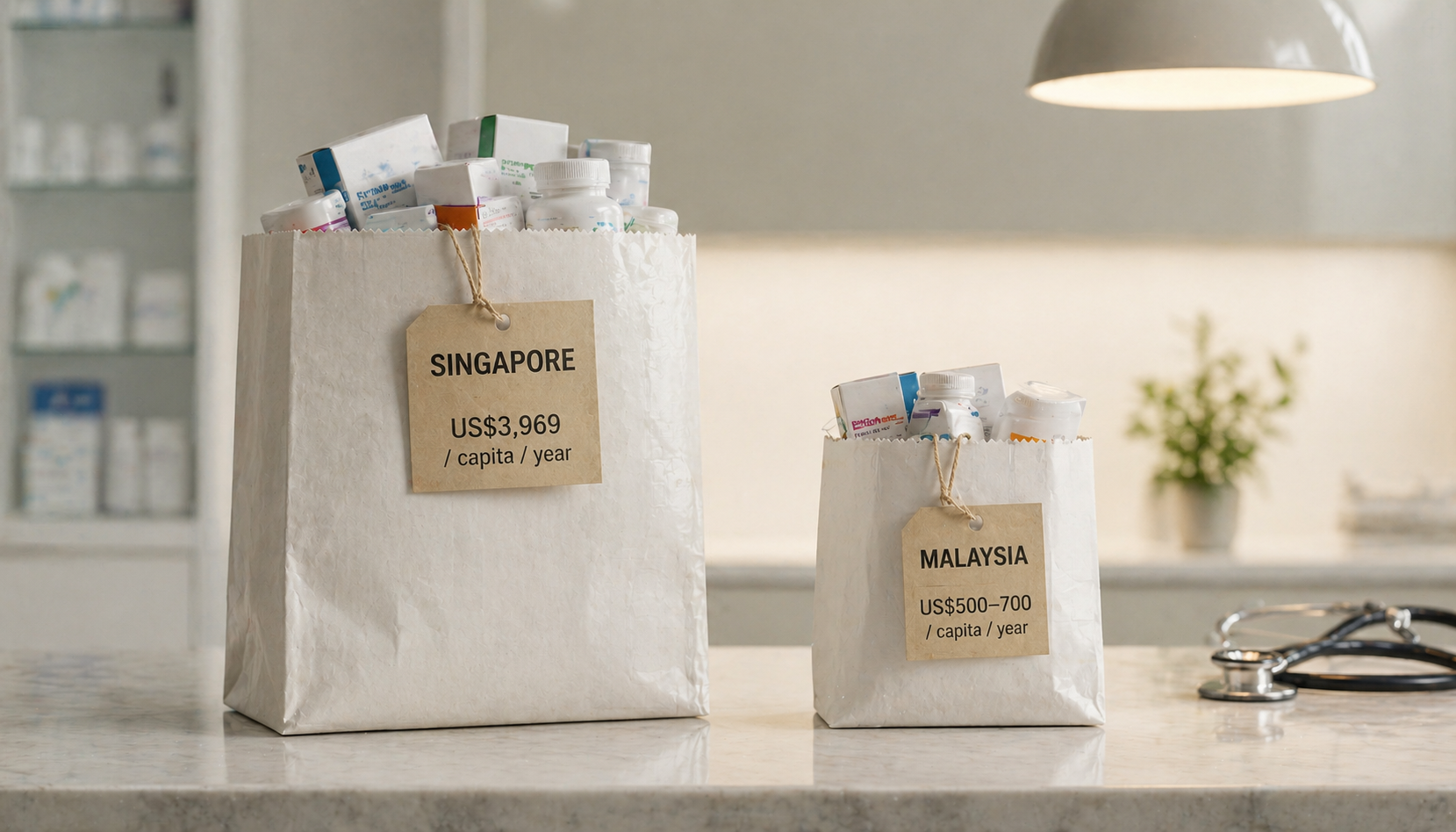
WHO's Global Health Expenditure Database reports total Singapore health expenditure (government plus private) at approximately US$3,969 per capita for the latest available year — placing Singapore as the sixth-highest health spender per capita in Asia. Malaysia's equivalent figure sits in the US$500–700 per capita range — roughly five to eight times lower.
The 2024 Malaysian healthcare budget was approximately RM45.3 billion (US$11.3 billion total). Per capita government spending sits well below Singapore's by every measure.
A change worth noting on the Malaysia side: from 1 July 2025, healthcare for non-Malaysians at private hospitals became subject to a 6% service tax. Healthcare for Malaysian citizens remains exempt. Singapore continues to apply 9% GST to private healthcare, with subsidies for citizens and PRs at public hospitals.
Comparing common procedures across the two countries is an article in itself, and the prices vary too widely between hospitals to draw clean conclusions in a stats roundup. As a rough guide: a normal childbirth at a private hospital costs S$13,000–18,000 in Singapore and RM5,000–8,000 in Malaysia. An appendectomy: S$15,000–25,000 versus RM12,000–18,000. The pattern holds.
8. Cross-border life: 244.86 million crossings, MM2H, and the Iskandar arbitrage
This is where the two countries become a single economy.
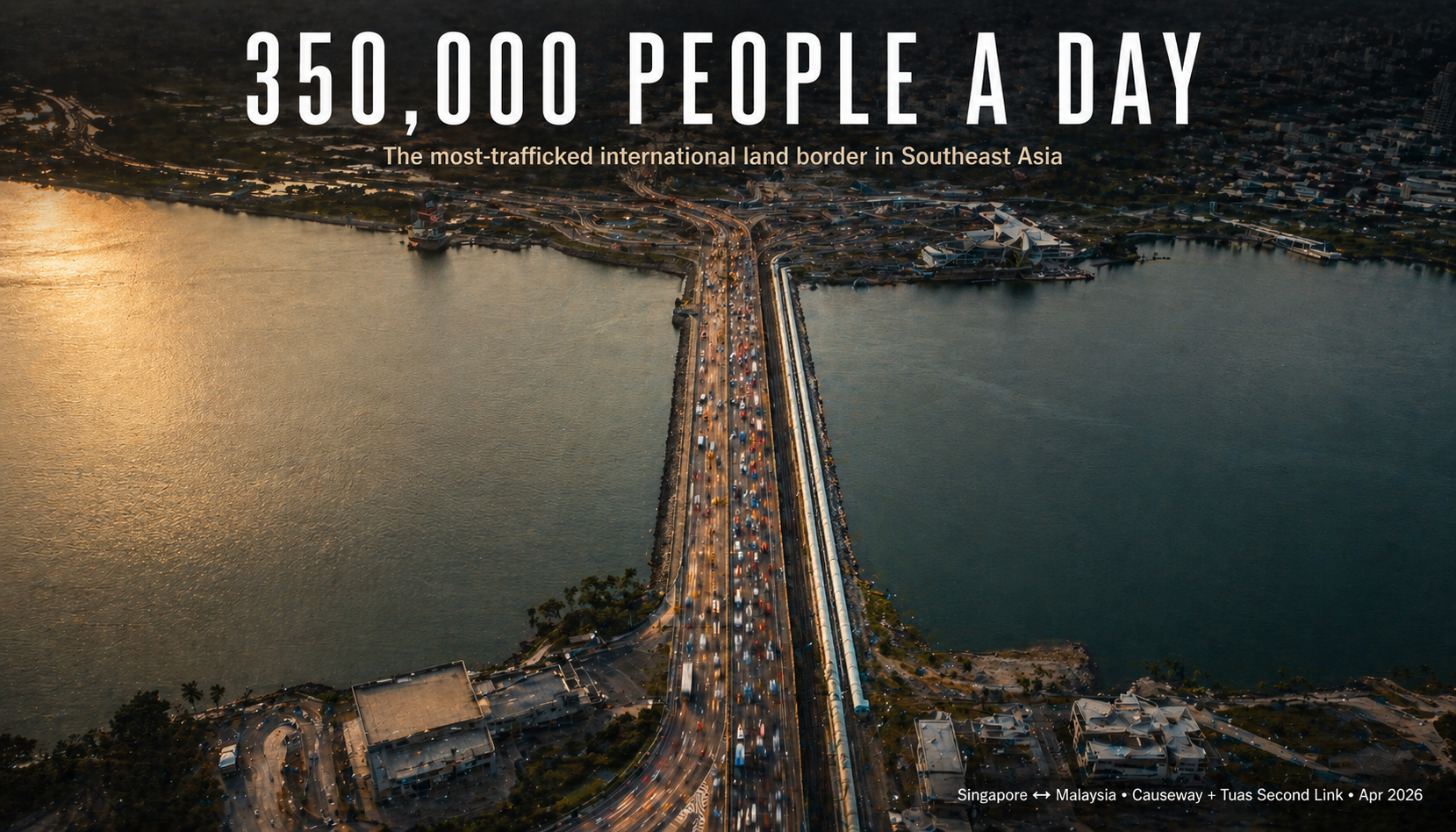
In 2025, Singapore's Immigration & Checkpoints Authority cleared 244,864,000 travellers at all the country's checkpoints — up 6.3% from 230,399,000 in 2024 (an increase of approximately 14.5 million travellers). The vast majority of that flow goes through the two land checkpoints at Woodlands and Tuas. The single-day record of 530,000+ travellers across the Causeway and Tuas Second Link, set on 14 June 2024 during the Hari Raya Haji long weekend, has not yet been broken — that long weekend alone cleared more than 2.4 million travellers across the four-day period.
Daily averages run around 350,000 across the two land checkpoints, peaking above 400,000 during festive periods. Among the daily flows: approximately 10,000 schoolchildren who live in JB and attend school in Singapore, and tens of thousands of cross-border workers commuting in either direction. Enterprise Singapore has called the Causeway "one of the world's busiest border crossings, averaging 350,000 travellers and 100,000 vehicles daily."
Behind the human flow sits a parallel financial flow. Cumulative Singapore investment in Iskandar Malaysia — the southern Johor development zone — reached RM45.8 billion by September 2023, accounting for approximately 25% of all foreign investment in the zone over the period 2006–2023. Singapore-based developers, manufacturers, logistics operators, and individual buyers have made Iskandar the single most concentrated cross-border investment relationship in Southeast Asia.
The Malaysia My Second Home (MM2H) programme provides the formal residency vehicle for that investment. Restructured in June 2024 into three tiers, MM2H now operates as follows. The Silver tier requires a US$150,000 fixed deposit with a Malaysian bank, plus a property purchase of at least RM600,000, in exchange for a five-year renewable visa for the principal applicant aged 21 or above and dependents. The Gold tier requires US$500,000 deposit and a RM1 million property purchase, in exchange for a 15-year visa. The Platinum tier requires US$1 million deposit, a RM2 million property purchase, and grants a 20-year visa with limited work rights. The minimum stay requirement across tiers is 60–90 days a year (cumulative across the principal and dependents). Properties acquired under the programme cannot be sold for ten years, except via upgrade.
More than 50,000 MM2H passes have been issued since the programme's inception in 2002. The largest applicant nationality is Chinese, followed by Japanese, British, and American. Singaporeans are eligible — and the math, especially for retirees, is increasingly compelling. A Singaporean couple aged 60 with S$2 million in CPF and private savings can comfortably qualify for the Silver tier, deploy roughly S$200,000 into a beach-fronting condo in Iskandar Puteri, retain S$190,000 (US$150,000) in a Malaysian fixed deposit earning ~3% — and live for materially less than they could in any HDB town in Singapore.
The Johor-Singapore Rapid Transit System, scheduled for late December 2026, will compress the friction further. A five-minute crossing means a Singaporean can — in theory — live in Bukit Chagar, work in Marina Bay, and commute on a fixed-cost transit pass priced for daily use. This will not be cheap, but it will be quantitatively cheaper than the current Causeway commute, and structurally faster.
Both countries' economies have spent the last decade preparing for what happens when those 1.05 kilometres become a five-minute train ride.
Live Calculator
Calculate the MM2H deposit in today's Singapore dollars
The Silver tier US$150,000 deposit — convert at live SGD/MYR rates.
9. Why are they so different? A brief historical note

For most of their modern history, Singapore and Malaysia were not separate economies.
The two were unified as part of the Federation of Malaysia from 16 September 1963 until 9 August 1965, when the Malaysian parliament passed the Constitution and Malaysia (Singapore Amendment) Act. Historical accounts of the vote consistently record a 126–0 result in favour of expelling Singapore from the federation — a unanimous decision driven by political and ethnic tensions between the People's Action Party-led Singapore government and the Alliance-led Kuala Lumpur federal government.
Lee Kuan Yew announced the separation in a televised press conference, weeping on camera. Singapore became an independent country with no natural resources, no domestic market, and no clear economic path. Malaysia retained the rubber, the tin, the oil, and what would later become the palm oil industry. By every measure available in 1965, Malaysia held the better hand.
Sixty-one years later, Singapore's GDP per capita is approximately US$84,734 (nominal, 2024). Malaysia's is approximately US$13,310. The ratio is 6.4 to 1. Singapore has 5.92 million people on 735 square kilometres. Malaysia has 33.93 million across 330,803 square kilometres — 450 times the land area, 5.7 times the population, one-sixth the per-capita income.
Most of the price gradients in this article are downstream of that single fact: that two countries which started in roughly the same place in 1965 chose radically different economic strategies, and have now diverged further than almost any other neighbouring-country pair on Earth.
10. The summary table
The 30 most important data points from this article, consolidated for reference:
| Category | Singapore | Malaysia | Difference |
|---|---|---|---|
| Numbeo Cost of Living Index 2026 (NYC=100) | 87.7 | ~30 | SG 2.9× more |
| Median monthly household market income (latest) | S$12,446 (2025) | RM7,017 / S$2,263 (2024) | SG 5.5× more |
| Median income per household member | S$4,160 (2025) | n/a | — |
| Average monthly net salary (Numbeo) | S$5,466 | RM3,691 / S$1,190 | SG 4.6× more |
| Statutory minimum wage | None (Progressive Wage Model only) | RM1,700 | — |
| Top personal income tax rate | 24% | 30% | MY 6 pts higher |
| Mandatory pension (employee+employer, under 55) | CPF 37% | EPF 23–24% | SG 13 pts higher |
| Consumption tax | GST 9% | SST 5–10% sales / 6–8% service | comparable |
| Apartment per sq ft (city centre) | S$2,794 | RM792 / S$255 | SG 11× more |
| 1BR rent city centre | S$3,428 | RM1,616 / S$521 | SG 6.6× more |
| 3BR rent city centre | S$7,013 | RM2,873 / S$926 | SG 7.6× more |
| HDB Resale Price Index Q1 2026 | 203.4 (−0.1% QoQ) | n/a | First decline since Q2 2019 |
| Median 4-room HDB resale (Queenstown) Q1 2026 | S$1,038,000 | n/a | — |
| Median 4-room HDB resale (Toa Payoh) Q1 2026 | S$1,000,000 | n/a | — |
| Million-dollar HDB resales Q1 2026 | 412 | n/a | — |
| Highest HDB resale Q1 2026 | S$1.7M (Dawson Rd, 5-room loft) | n/a | — |
| COE Cat A — Apr 2026 2nd bidding | S$123,010 | n/a | — |
| COE Cat E — Apr 2026 2nd bidding | S$125,002 | n/a | — |
| Toyota Corolla equivalent — new car price | S$174,275 | RM139,514 / S$44,977 | SG 3.9× more |
| Petrol per litre (April 2026, 95-octane) | ~S$3.05 unsubsidised | RM1.99 / S$0.64 (BUDI95) | SG ~4.8× more |
| Monthly transit pass | S$122 | RM50 / S$16 | SG 7.6× more |
| Inexpensive restaurant meal | S$13 | RM15 / S$4.84 | SG 2.7× more |
| Pint of beer (domestic draft) | S$10 | RM15 / S$4.84 | SG 2.1× more |
| Cigarettes (Marlboro pack) | S$17.62 | RM18 / S$5.80 | SG 3.0× more |
| Government health spending per capita | ~S$3,100 (FY2021, derived) | est. ~S$700 | SG ~4–5× more |
| 2025 SG checkpoint clearances | 244,864,000 (+6.3% YoY) | (same) | — |
| Single-day border record | 530,000+ (14 Jun 2024) | (same) | — |
| MM2H Silver visa entry | n/a | US$150K + RM600K property | — |
| GDP per capita 2024 (nominal, IMF) | ~US$84,734 | ~US$13,310 | SG 6.4× more |
| Land area | 735 km² | 330,803 km² | MY 450× larger |
| Population (2024) | 5.92M | 33.93M | MY 5.7× more |
11. Frequently asked questions
Is Malaysia cheaper than Singapore? Yes. The cost of living in Malaysia is 60.7% lower than Singapore excluding rent, and 70.6% lower including rent (Numbeo, April 2026). The biggest gaps are housing (rent is 86.5% lower) and transport (a Toyota Corolla costs 74% less). Local purchasing power, which factors in income, is 25.9% lower in Malaysia — meaning Singaporeans earn substantially more, but everything they spend it on costs proportionally more too.
How much cheaper is Kuala Lumpur than Singapore? To match the lifestyle of someone earning S$12,000 a month in Singapore — assuming you rent rather than own — you would need approximately S$4,290 (RM13,175) a month in Kuala Lumpur. That is roughly 64% less. Outside KL, the gap widens further: Penang and Ipoh run another 15–25% lower again.
Is Singapore the most expensive city in Asia? Yes, by every major index. Singapore was tied for first place globally with Zurich on the Economist Intelligence Unit's 2024 Worldwide Cost of Living Index, ranks fifth most expensive country worldwide on Numbeo's 2026 index (score 87.7, where New York is 100), and sits sixth in Mercer's 2025 Cost of Living City Ranking — the highest in Asia.
What is the average salary in Singapore vs Malaysia? Singapore's average net monthly salary, after taxes and CPF, is S$5,466 (about RM16,954). Malaysia's average net monthly salary is RM3,691 (about S$1,190). Singapore's is approximately 4.6 times higher. On a household basis, Singapore's median monthly market income reached S$12,446 in 2025; Malaysia's median monthly household income was RM7,017 in 2024 — a ratio of 5.5 to 1.
How much does it cost to own a car in Singapore vs Malaysia? A new Toyota Corolla equivalent costs S$174,275 in Singapore and RM139,514 (S$44,977) in Malaysia — Singapore is 3.9 times more expensive per car. Singapore drivers also need a Certificate of Entitlement (COE), which closed at S$125,002 (Cat E) in April 2026's second bidding exercise. The COE alone — a piece of paper, with no car attached — costs roughly the same as four to nine new cars in Malaysia.
How much cheaper is petrol in Malaysia? RON95 petrol in Malaysia costs RM1.99 per litre for citizens enrolled in the BUDI95 subsidy programme, or RM3.87 per litre unsubsidised. Singapore unsubsidised pump prices were approximately S$3.00–S$3.10 per litre in April 2026. Singapore petrol is roughly 4.8 times more expensive than the subsidised Malaysian rate, or 2.4 times more expensive than the unsubsidised one.
What is Singapore's tax rate vs Malaysia's? Singapore's personal income tax tops out at 24% on chargeable income above S$1,000,000. Malaysia's tops out at 30% on chargeable income above RM2,000,000. However, Singapore's mandatory CPF contribution takes 37% of wages (17% employer + 20% employee), versus Malaysia's EPF at 23–24% combined. The "tax wedge" — total mandatory wage deductions — is therefore roughly 13 percentage points higher in Singapore, partly offsetting the lower headline income tax rate.
Is Singapore part of Malaysia? No. Singapore was part of the Federation of Malaysia for two years (1963–1965). On 9 August 1965, the Malaysian parliament passed the Constitution and Malaysia (Singapore Amendment) Act, expelling Singapore from the federation. The two have been separate sovereign nations ever since.
How many people cross the Singapore-Malaysia border every year? In 2025, Singapore's Immigration & Checkpoints Authority cleared 244,864,000 travellers at all the country's checkpoints — about 6.3% more than 2024. Average daily crossings at the Causeway plus Tuas Second Link run around 350,000, peaking above 400,000 during festive periods. The single-day record is 530,000+ travellers, set on 14 June 2024 during the Hari Raya Haji long weekend.
What is MM2H? Can a Singaporean retire in Malaysia under it? Yes. Malaysia My Second Home is the country's long-term residency visa, restructured in June 2024 into three tiers — Silver (US$150,000 deposit + RM600,000 property + 5-year visa), Gold (US$500,000 + RM1 million + 15-year visa), and Platinum (US$1 million + RM2 million + 20-year visa with limited work rights). Singaporeans are eligible. Properties acquired must be held for ten years before resale, except via upgrade. More than 50,000 MM2H passes have been issued since 2002.
12. Methodology and sources
This article is built from 70 verified data points across 26 primary sources. Every Singapore government figure has been verified against its primary gov.sg source (Department of Statistics, Ministry of Manpower, IRAS, CPF Board, HDB, URA, LTA, MOH, ICA, MOT) via Perplexity Pro Deep Research mode on 28 April 2026. Malaysian government figures are cited directly from dosm.gov.my, hasil.gov.my, kwsp.gov.my, mof.gov.my, data.gov.my, and the official MM2H portal. International benchmarks come from Numbeo (most recent contributor update 24–26 April 2026 for SG and MY respectively), the Economist Intelligence Unit (Worldwide Cost of Living 2024), Mercer (Cost of Living City Ranking 2025), the World Bank, the IMF World Economic Outlook, and the WHO Global Health Expenditure Database.
Currency conversions throughout this article use the live SGD-MYR mid-market rate via our SGD to MYR converter. Static comparison figures use a reference rate of S$1 = RM3.10. The exact rate at the moment you read this may differ; the converter linked above will always show today's value.
Where Singapore and Malaysia publish income and household data on different schedules — Singapore released 2025 figures in February 2026, while Malaysia released 2024 figures in October 2025 — we use the latest available official figure from each country and clearly state the year. Where Singapore government data is available only via property analyst aggregations of HDB open transaction data (specifically, million-dollar resale counts and record-price flagging), we cite the analyst — typically PropNex, OrangeTee, or 99.co — rather than HDB directly. Where a published per-capita figure does not exist (specifically for government health expenditure), we self-derive from MOH's published total and SingStat's resident population, and disclose the derivation.
This article will be quarterly-updated to track HDB and URA Q1/Q2/Q3/Q4 releases, COE bidding results, Singapore Budget changes, Malaysian budget and policy changes, and any updates to MM2H rules or RTS commencement dates. If you spot an error or have a sourced data point we should incorporate, write to editorial@smartcalculator.sg.
Related calculators
- SGD to MYR converter — live mid-market exchange rate
- Singapore salary calculator — gross-to-net pay including CPF
- Singapore income tax calculator — IRAS-based progressive tax calculation
- CPF contribution calculator — full breakdown by age band
- HDB affordability calculator — BTO and resale eligibility
- Total cost of car ownership calculator — 10-year total inclusive of COE
Last research verification: 28 April 2026. Next scheduled refresh: Q3 2026 (HDB / URA quarterly release).
Get your free Singapore Budget Planner
Download the printable budget planner instantly — free with newsletter signup.
Related Articles
16 Jun 2026
How COE Bidding Works in Singapore (2026): Categories, Prices & Dates
How Singapore's COE bidding works: the 5 categories, when bidding happens, how the Quota Premium price is set, and where the quota comes from. Plain-English 2026 guide.
14 Jun 2026
How to Divorce in Singapore 2026: CPF, HDB & Asset Split
A practical guide to divorce in Singapore 2026 — Women's Charter timelines, CPF refund vs matrimonial split, HDB ownership rules, and decoupling implications.
14 Jun 2026
How to Apply for Singapore Citizenship 2026: ICA Timeline & Checklist
A practical walk-through of applying for Singapore citizenship in 2026 — eligibility, ICA timeline expectations, NS obligation for male applicants, what to prepare.
Ready to run the numbers?
All our calculators are free, updated for 2026, and built for Singapore.